It’s Worse Than Anyone Thought: Van Damme Destroys Steven Seagal in Brutal Confession About Their Explosive History The silence is over, and Jean-Claude isn’t holding back. From public insults to private betrayal, his truth is finally out—and it’s damning.
amme Just Revealed About Steven Seagal—And Why Hollywood May Never Be the Same
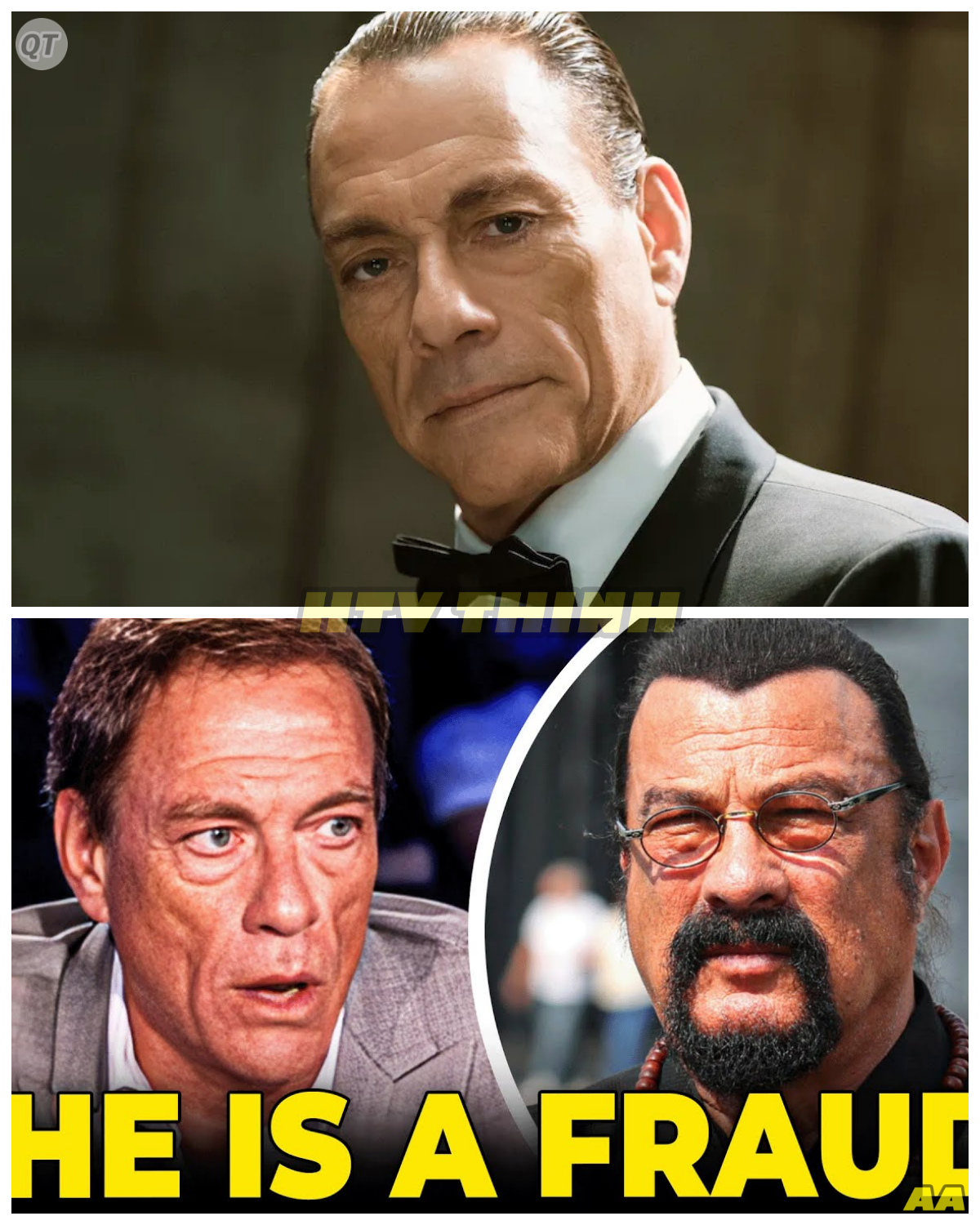
For decades, the names Jean-Claude Van Damme and Steven Seagal have echoed through the action movie halls of Hollywood.
Their rivalry was whispered about in gyms, on film sets, and in late-night interviews.
Fans debated who would win in a real fight, who was the true martial arts master, and whether the rumors of their near-confrontations were true.
But behind the scenes, something darker was brewing.
It began quietly, almost imperceptibly.
In the late 1980s, both men were on the rise.
Jean-Claude Van Damme, with his Belgian charm, dazzling splits, and ballet-like kicks, captured the imagination of audiences worldwide.
Movies like “Bloodsport” and “Kickboxer” turned him into an icon almost overnight.
He was the “Muscles from Brussels,” a man whose discipline and humility made him beloved by fans and colleagues alike.
Meanwhile, Steven Seagal was carving out his own legend.
With his imposing stature, stoic demeanor, and mastery of aikido, he brought a new kind of intensity to the screen.
His debut in “Above the Law” was a revelation, and soon he was starring in hit after hit.

He projected an aura of danger, both on and off camera.
But as their careers soared, so did the rumors.
Stories began to circulate—whispers of tension, jealousy, even outright hostility.
Some said it was professional rivalry.
Others believed it was personal.
The two men were rarely seen together, and when they were, the atmosphere was electric with possibility—and threat.
It all came to a head at a Hollywood party in the early 1990s.
By then, the feud had become the stuff of legend.
Accounts differ, but one thing is certain: Jean-Claude Van Damme challenged Steven Seagal to a fight.
Some say Seagal laughed it off.
Others claim he left the party to avoid a confrontation.
For years, the truth remained elusive, shrouded in rumor and bravado.
Neither man spoke openly about what happened that night.
But the legend grew, taking on a life of its own.
Fans begged for closure, for a real showdown, for the truth.
But the silence persisted—until now.
Recently, Jean-Claude Van Damme broke his silence.
It began with a cryptic Instagram post—a photo of himself in a dimly lit gym, staring into the mirror, the caption reading simply: “Sometimes, the past is heavier than the weights.”
Fans went wild.
Speculation exploded online.
Was this a sign of reconciliation?
A hint at a long-awaited fight?
Or something else entirely?
Days later, Van Damme sat down for an interview.
His demeanor was calm, almost meditative.
He spoke of the rivalry, the years of tension, and the burden of carrying a legend that was never truly his own.
He admitted that the feud had cost him dearly—not just in opportunities, but in friendships, in peace of mind, in the simple joy of making movies.
Then he dropped the bombshell.
According to Van Damme, the rivalry was never about martial arts, or fame, or money.
It was about respect.
He described moments on set where Seagal would belittle crew members, dismiss stuntmen, and act as if he were untouchable.
He recalled a specific incident during a charity event, where Seagal’s behavior left several people in tears.
Van Damme said he tried to intervene, to smooth things over, but was met with coldness and contempt.
He realized then that the feud was not just between two men—it was a clash of values.
For Van Damme, martial arts was about discipline, humility, and lifting others up.
For Seagal, it seemed to be about dominance and control.
The revelation stunned fans.
For years, the narrative had been simple: two titans, locked in a battle of egos.
But now, the story was more complicated, more human.
Van Damme spoke of regret.
He wished he had tried harder to reach out, to find common ground.
He admitted to moments of anger, of pride, of wanting to prove himself.
But he also acknowledged that both men were products of their time—shaped by Hollywood’s relentless pressure, by the expectations of fans, by the myth of the invincible action hero.
The interview took a surprising turn.
Van Damme revealed that, just months earlier, he had reached out to Seagal privately.
He wanted to bury the hatchet, to let go of the past.
He sent a message: “We are both older now. Life is short. Let’s talk.”
For weeks, there was no reply.
Then, out of nowhere, Seagal posted a cryptic message of his own.
A photo of a closed fist, captioned: “Some things are better left unsaid.”
The internet erupted.
Was this a rejection?
A challenge?
Or simply the final word on a feud that had defined two lifetimes?
Van Damme admitted he was hurt.
He had hoped for resolution, for peace.